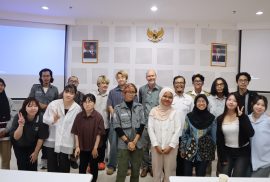
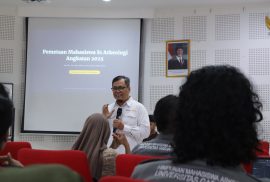
The Community Service Team of the Department of Archaeology, Faculty of Cultural Sciences, Universitas Gadjah Mada, held a Focus Group Discussion (FGD) in Kauman, Yogyakarta, on Monday (29 June). Held at the Secretariat Building of the Takmir of the Great Mosque of Kauman, the discussion was part of a community service program entitled “Strategies for Developing Kauman as an Archaeological-Historical Educational Tourism Destination,” which also involved students from the Master’s Program in Archaeology at UGM.
The FGD brought together the community service team, Master’s students in Archaeology, and representatives of the Kauman community, including neighborhood representatives, the Kauman Tourism Awareness Group (Pokdarwis), Saka Wisata Kauman, and the Takmir of the Great Mosque of Kauman. Led by Dr. Mahirta, M.A., the discussion aimed to explore existing tourism management, storytelling practices, and opportunities for developing educational tourism in Kauman.

The discussion explored various aspects of Kauman’s history and development. One of the topics was the growth of the batik industry, including the presence of approximately 18 batik entrepreneurs in Kauman during the 1970s. The development of the industry contributed to the growth of the settlement and changes in residential architecture. In addition to batik, the FGD also highlighted the development of Kauman songket weaving around the 1920s, which was once incorporated into clothing worn by Aisyiyah activists.
Architecture was another important aspect discussed during the FGD. Several houses associated with khatibs and batik entrepreneurs still retain elements of their historic structures despite subsequent alterations. One relatively well-preserved khatib house is located at the residence of Budi S. in RW 12. The discussion also highlighted houses with langgar dhuwur, or prayer spaces located on the upper floor of a building. The traditional Javanese characteristics of Kauman houses were identified as another potential element for developing historical tourism narratives.
Currently, Saka Wisata Kauman guides visitors to several locations, including the Great Mosque, Kauman Cemetery, Langgar Ahmad Dahlan, Langgar Dhuwur, Aisyiyah Prayer House, TK ABA Kauman, the Filsabilillah Monument, and nDalem Pengulon. Khatib houses and former batik entrepreneurs’ residences, meanwhile, are generally introduced through storytelling due to the limited duration of tours, which typically last around one hour.

The FGD also addressed challenges in developing tourism in Kauman, particularly the limited foreign-language skills among local guides. As one possible solution, the community service team proposed the use of QR codes containing historical information in both Indonesian and English. Collaboration with the Faculty of Cultural Sciences at UGM was also discussed as a possible way to support foreign-language training.
The results of the FGD will serve as a basis for the community service team and participating Master’s students in Archaeology to support the development of educational tourism materials for Kauman. The team is also planning a workshop, a follow-up FGD, and a mini exhibition in late October featuring historical information and documentation related to Kauman, including saudagaran batik, khatib houses, and other historical heritage.