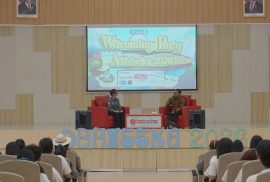
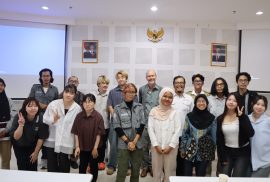
Surabaya, October 10, 2026 — Stefani Adelia Tiurma Mukti, a student from the Department of Archaeology, Faculty of Cultural Sciences, Universitas Gadjah Mada (UGM), collaborated with Fadel Ilham Dzulkarnain from the Multimedia Engineering Technology Study Program, Politeknik Elektronika Negeri Surabaya (PENS), in developing a research paper titled “From Prediction to Preservation: An Explainable AI and WebGIS Framework for Simulated Archaeological Heritage Conservation in Trowulan, Indonesia.” The paper was presented at the iCAST-SS conference organized by PENS on October 9–10, 2026, at the Platinum Hotel, Surabaya.
This study highlights the application of Explainable Artificial Intelligence (Explainable AI) and Web-based Geographic Information Systems (WebGIS) as an approach to support heritage conservation planning in Trowulan, East Java. The Trowulan area was chosen as the research site due to its historical significance in archaeological studies and the preservation of the Majapahit Kingdom’s cultural heritage.
Through this research, the two students explored a framework that integrates predictive modeling with spatial information visualization. This approach aims to assist in identifying potential archaeological sites in a simulated environment while presenting the analytical results through an accessible WebGIS platform. Meanwhile, the implementation of Explainable AI enhances model transparency by providing insights into the contributing factors behind prediction outcomes.

This collaboration bridges archaeological perspectives with multimedia technology to address cultural heritage preservation challenges. From the archaeological standpoint, the study considers spatial context essential for understanding potential archaeological remains. From the technological standpoint, AI-based modeling and WebGIS development serve to process and present data in a more systematic and communicative manner.
Participation in the iCAST-SS 2026 conference provided an opportunity to introduce digital technology concepts for cultural heritage preservation to an interdisciplinary academic forum. The study also demonstrates potential opportunities for integrating archaeology with computing and information technology to support decision-making in cultural heritage management.
Although developed within a simulated framework, this research paves the way for further development—particularly through field validation, predictive model refinement, and practical application testing in archaeological conservation and management contexts. Consequently, utilizing AI and WebGIS is expected to serve as a supporting framework that connects scientific analysis with the practical demands of cultural preservation.
Through this collaborative effort, Stefani Adelia Tiurma Mukti and Fadel Ilham Dzulkarnain demonstrate the strong potential of cross-disciplinary partnerships in designing innovative approaches for Indonesian archaeological conservation, particularly in the Trowulan area.