• English
    • English
    • Bahasa Indonesia
Universitas Gadjah Mada Department of Archaeology
Faculty of Cultural Sciences
Universitas Gadjah Mada
  • Home
  • Profil
    • Department’s Vision and Mission
    • History
    • Teaching Staff
    • Organizational Structure
    • Facilities
  • Academic
    • Undergraduate
      • Vision and Mission
      • Curriculum
    • Master Program
      • Master’s Vision and Mission
      • Master’s Teaching Staff
    • Academic Guide
      • Undergraduate Study Program
      • KKN-PPM
      • Graduation Ceremony and Commencement
  • Partnership
    • National Partner
    • International Partnership
  • Publications
    • Lecturer Publications
    • Student Publications
    • BA Thesis
    • Master Thesis
    • Janus
    • Artefak Megazine
  • Activities
    • Community Service
    • Lecturer Research
    • HIMA
    • News
  • Admission
    • Scholarship
    • Faculty Courses
  • Home
  • Berita

Archaeology Student on Community Service Program in Sapuran Proposes Garbology Study to Address Waste Management Crisis

  • Berita
  • 30 January 2026, 21.03
  • By : arkeologi

Wonosobo, January 30, 2026 — Teodora Septina Sambarana, an undergraduate student of the Archaeology Study Program at Universitas Gadjah Mada (UGM) currently undertaking a Community Service Program (KKN) in Sapuran Village, Wonosobo Regency, Central Java, has proposed the application of garbology studies to uncover community behavior patterns related to waste management. This approach treats waste as contemporary artifacts that accurately reflect consumption habits.

Garbology originated from the Tucson Garbage Project, pioneered by William Rathje in 1973. The research revealed that people discard around 10 percent of the food they purchase and consume alcohol at levels two to three times higher than reported in surveys. “Waste is more honest than surveys,” Teodora emphasized, quoting Rathje & Murphy (2001).

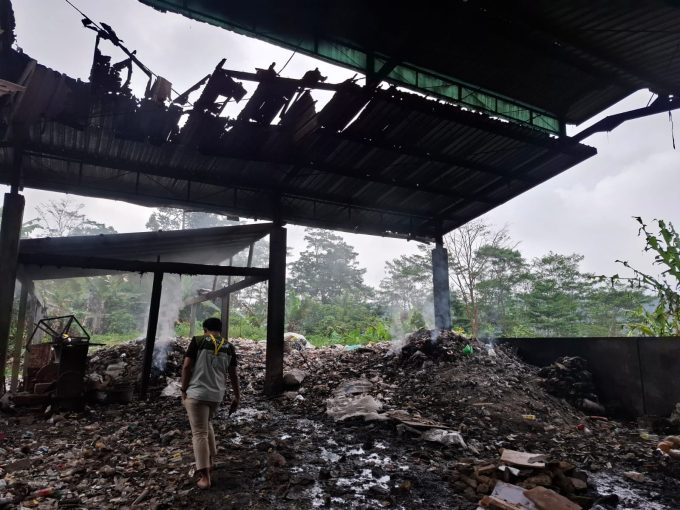
Sapuran Village, which holds strong potential for cultural tourism amid its lush natural environment, faces challenges due to low public awareness of proper waste management. Plastic waste, beverage bottles, and household refuse are frequently dumped into rivers, forming layers of modern waste that risk triggering landslides and pollution. “Garbology studies can identify current consumption patterns, prevent waste accumulation, and help protect the village’s historical sites,” she explained.

At the national level, Indonesia generates 68 million tons of waste annually (Ministry of Environment and Forestry, 2025), with 46 percent of rivers polluted. The Bantar Gebang Landfill receives around 8,000 tons of waste per day, while the Citarum River absorbs 15,838 tons daily, making it one of the most polluted rivers in the world (World Bank, 2023). In Sapuran, dumping waste into river basins degrades ecosystems and passes on serious health risks to future generations.

Garbology methodology involves classifying waste into 35 categories, including organic matter, plastics, and metals, using excavation techniques with 1.5 × 1.5 meter grids. Rathje’s studies in the 1980s found that snack food packaging dominated waste deposits, indicating excessive consumption often unacknowledged by survey respondents. “This approach is more accurate than subjective surveys,” Teodora added.

Garbology is inherently prescriptive. Waste analysis can serve as the foundation for waste-sorting training programs, the establishment of waste banks, and the development of recycling-based social enterprises, targeting a 30 percent reduction of waste in river basins and 70 percent community participation. If left unaddressed, today’s waste could become a form of disaster archaeology site in the future.

By comparison, prehistoric European communities left behind kjøkkenmøddinger (kitchen middens) around 10,000 BCE, which reveal their consumption patterns, while traditional Indonesian waste was largely biodegradable and naturally decomposed into fertilizer. Industrialization has drastically altered this dynamic, making early waste segregation a crucial step toward sustainability.
Leave A Comment Cancel reply

Your email address will not be published. Required fields are marked *

*

Related Posts

UGM Archaeology Opens Elective Courses for Non-Archaeology Students

Berita Friday, 30 January 2026

The Undergraduate Archaeology Program at Universitas Gadjah Mada offers elective courses that are open to students from non-archaeology disciplines, encouraging interdisciplinary learning and the application of archaeological perspectives to contemporary social and environmental issues.

UGM Department of Archaeology Welcomes Postdoctoral Researcher from the University of Adelaide

Berita Friday, 26 December 2025

The Department of Archaeology at Universitas Gadjah Mada welcomed an academic visit from Gludhug A. Purnomo, a Postdoctoral Research Associate from the University of Adelaide, on December 26, 2025.

Camella Sukma Dara: UGM Archaeology Alumnus Presents on Textile Conservation at Cultural Heritage Seminar

AlumniBerita Saturday, 13 December 2025

Camella Sukma Dara, S.S., M.A., an alumna of the Archaeology Program at Universitas Gadjah Mada, was a speaker at the Cultural Heritage Conservation Seminar held on December 13, 2025.

UGM Archaeology Welcomes Visiting Student from Udayana University

Berita Saturday, 22 November 2025

The Archaeology Study Program at Universitas Gadjah Mada welcomed an academic visit from Gloria Rosniat Waruwu, an Archaeology student from Universitas Udayana, on November 21, 2025. Gloria was formally received by the Head of the […].

ARSIP

  • UGM Archaeology Opens Elective Courses for Non-Archaeology Students
  • Archaeology Student on Community Service Program in Sapuran Proposes Garbology Study to Address Waste Management Crisis
  • UGM Department of Archaeology Welcomes Postdoctoral Researcher from the University of Adelaide
  • Camella Sukma Dara: UGM Archaeology Alumnus Presents on Textile Conservation at Cultural Heritage Seminar
  • UGM Archaeology Welcomes Visiting Student from Udayana University
Universitas Gadjah Mada

Department of Archaeology
Faculty of Cultural Sciences
Universitas Gadjah Mada
Sosio-Humaniora Street, Bulaksumur, Yogyakarta 55281, Indonesia
Tel: +62 274 513096 Fax: +62 274 550451
E-mail: arkeologi@ugm.ac.id

© Department of Archaeology, UGM